

Remember when office betting pools were simple? Throw $20 in the hat, winner takes all, done. Or splitting a single bet between friends and spreading the win via Venmo?

Prediction markets changed the game. Whether you’re on Polymarket, Kalshi (now available through Coinbase in all 50 states), or Binance — you and your friends can pool capital on anything from elections to earnings calls to the Super Bowl. The problem? You’re not placing bets—you’re trading tokens and event contracts.
And when your buddy in London, your cousin in Berlin, and your college roommate in Austin all chip into the same pool, someone has to handle the accounting when the Pats win.

That someone is usually whoever set up the wallet. Congratulations, you’re now running a multi-jurisdictional trading desk for your fantasy league.
The Scale of the Problem
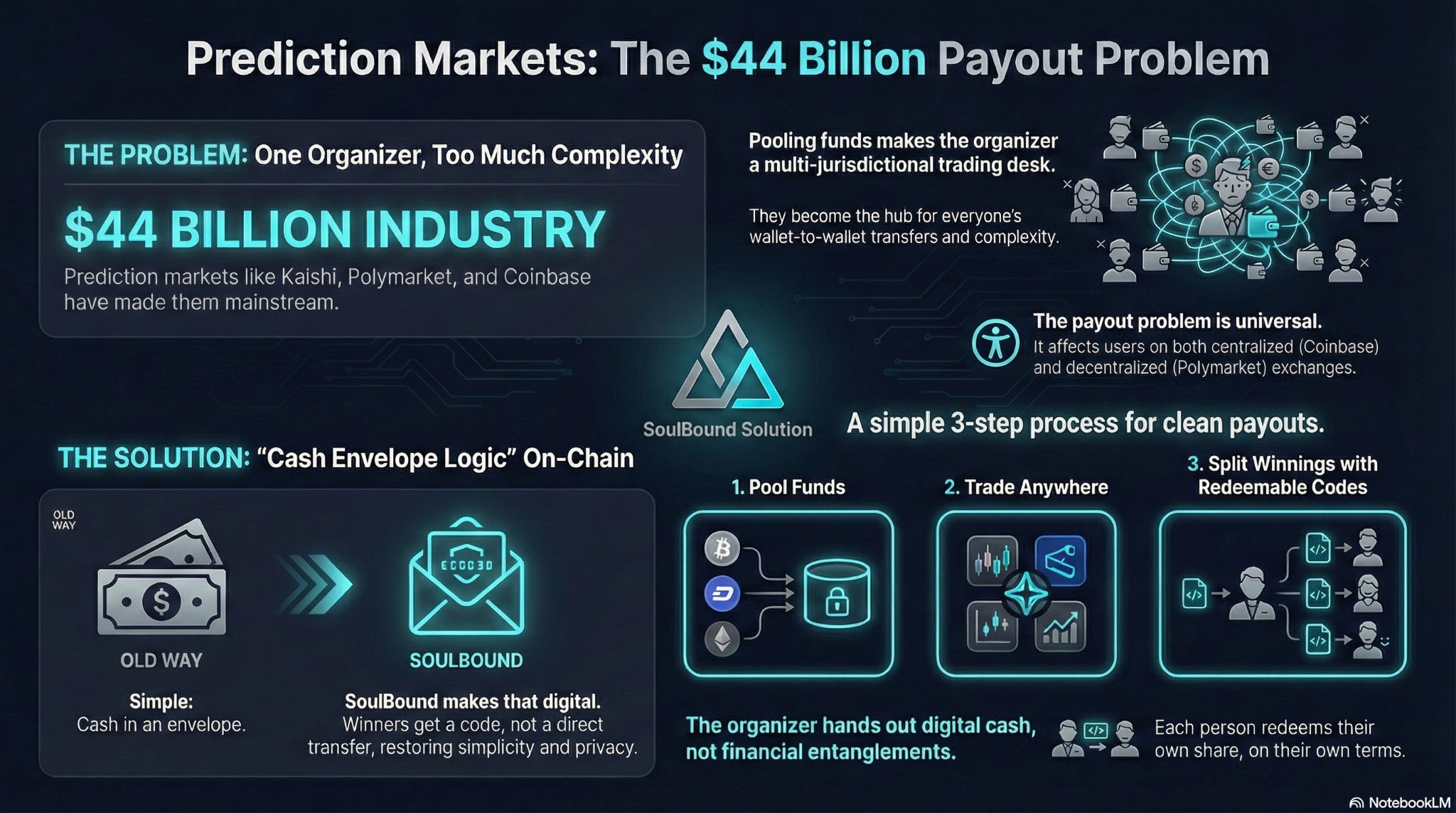
This isn’t a niche issue. Prediction markets did $44 billion in combined volume in 2025. Kalshi alone is valued at $11 billion. Coinbase just launched prediction markets nationwide. These aren’t fringe platforms anymore—they’re becoming default infrastructure for information discovery.
But the tooling assumes solo traders, not groups.
The Cash Model
Here’s how it used to work with physical cash: everyone throws money in an envelope, winner gets the envelope, everyone handles their own business. Simple. Clean. The pool organizer isn’t responsible for what happens after the handoff.
SoulBound brings that model on-chain.
How It Works
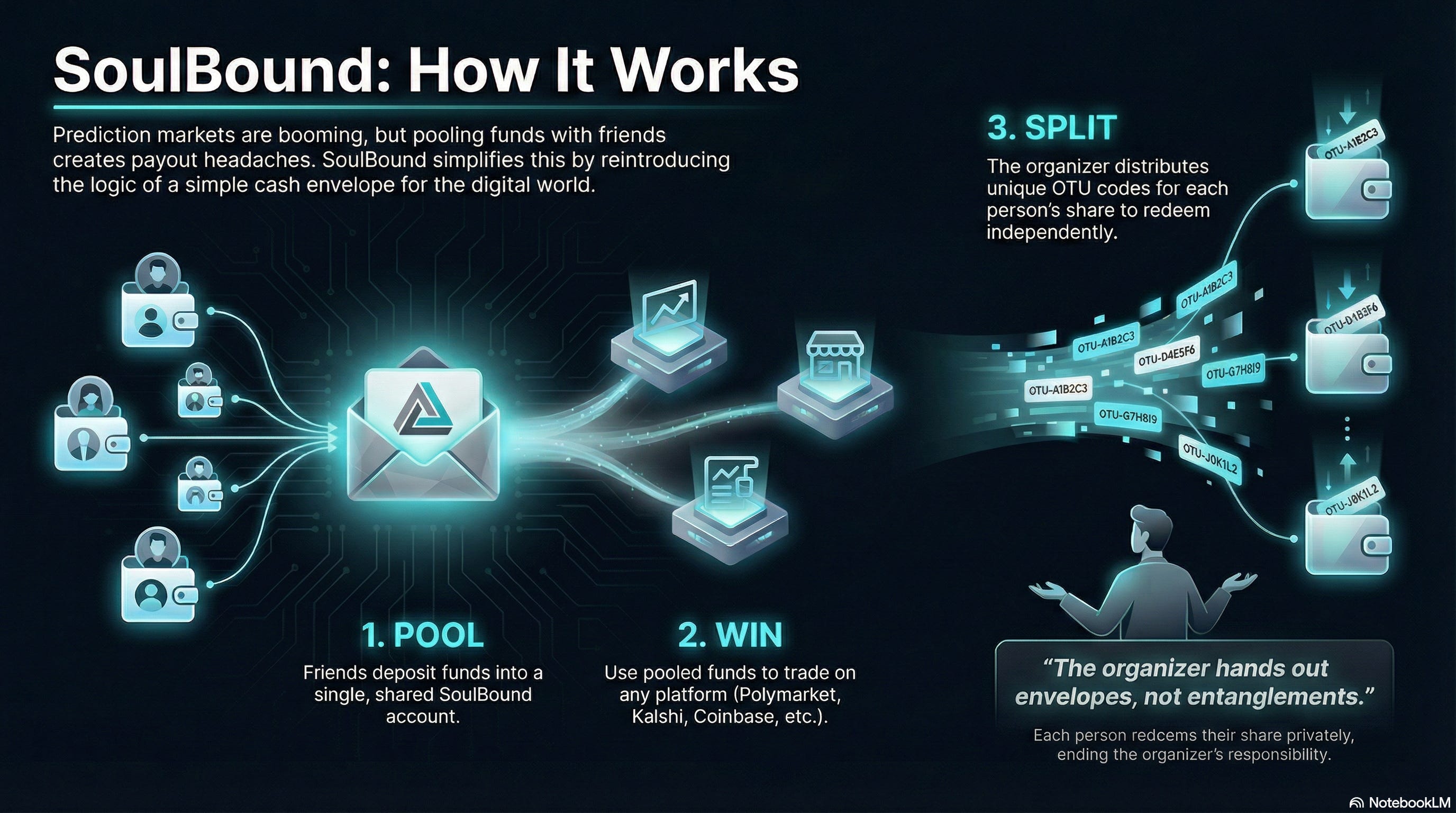
Your group deposits USDC into a shared SoulBound account (one person sets it up, others contribute, privately via SoulBound if desired)
The pooled funds are used to trade on Polymarket, Kalshi, Coinbase, Binance—wherever
When you win, the organizer generates OTU codes—one for each participant’s share
Each person redeems their own code to their own wallet
The organizer distributes bearer instruments, not wallet-to-wallet transfers. Each winner receives what’s essentially digital cash—redeemable anywhere, by anyone holding the code. What they do with it after that is their business, in their jurisdiction, on their own timeline.
CEX or DEX—Same Problem
Doesn’t matter if you’re on a centralized exchange like Coinbase or Binance, or a decentralized protocol like Polymarket. The moment you pool with friends across borders:
One wallet holds everything
Payouts create wallet-to-wallet transfer chains
The organizer becomes the hub for everyone’s downstream complexity
Whether the prediction market is regulated (Kalshi/Coinbase) or decentralized (Polymarket), the payout problem is identical.
What Groups Actually Need
Privacy between members (not everyone wants the pool to see their full wallet history)
Clean separation at payout (no single point of distribution complexity)
Cash-like finality (once you hand over the code, you’re done)
SoulBound delivers all three. Pool together, win together, split cleanly.
The Bigger Picture
This isn’t just about Super Bowl squares. It’s about any scenario where groups coordinate capital and need to distribute returns without one person becoming the back-office:
International teams splitting project revenue
Creator collectives dividing sponsorship money
Investment clubs distributing profits
Fantasy sports with actual stakes
Anywhere you’d say “let’s just Venmo each other after”—except Venmo doesn’t work across borders, exposes transaction history, and makes one person the hub.
SoulBound makes group finance work like handing out envelopes. Digital cash for a digital world.
SoulBound launches on Arbitrum Q2 2026.