

Stablecoins had $27.6 trillion in transaction volume last year. USDC is live on every major blockchain. Circle just got conditional OCC approval for a national trust charter. Stripe bought Bridge for $1.1 billion. The infrastructure for moving dollars on-chain has never been better.
So why is a $1,500 donation to a veterans’ charity still losing $124.54 to a payment processor?
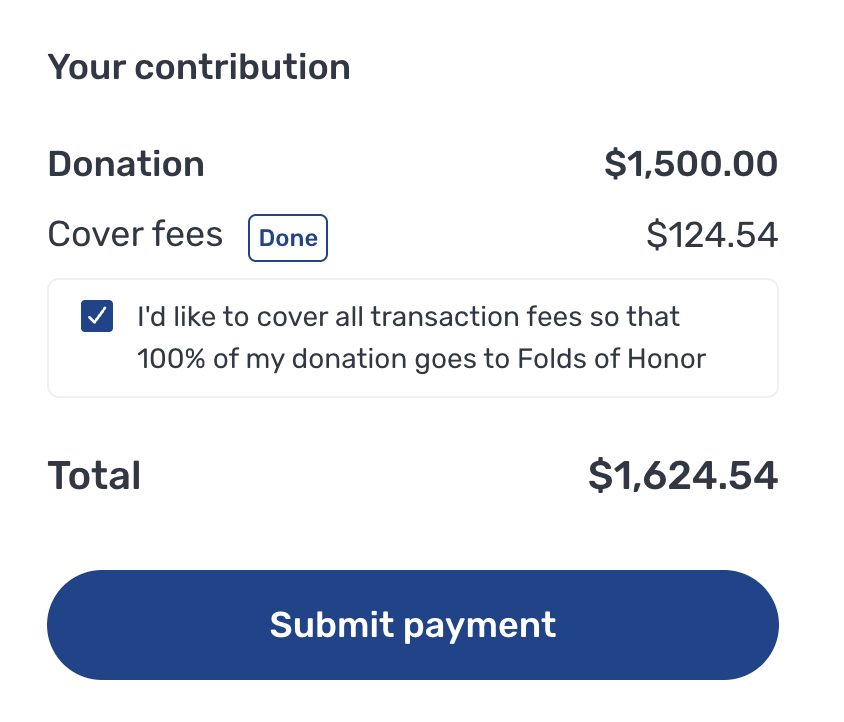
That’s a real screenshot. A real donation to Folds of Honor — a 4-star Charity Navigator organization that funds scholarships for families of fallen service members. Our investor Alpha Research Group sponsored their tournament at TPC Treviso Bay this week. 8.3% gone before a dollar hits the mission.
The standard credit card processing fee for charitable donations is 2.9% plus 30 cents. However, when you stack the platform fee, the gateway fee, and the administrative layer on top of that 2.9%, the “cover the fees” checkbox becomes effectively mandatory - or the organization will be routinely losing 5-10% per transaction.
This is the most broken payment rail in finance. And it’s enormous.
The Market Nobody’s Building For
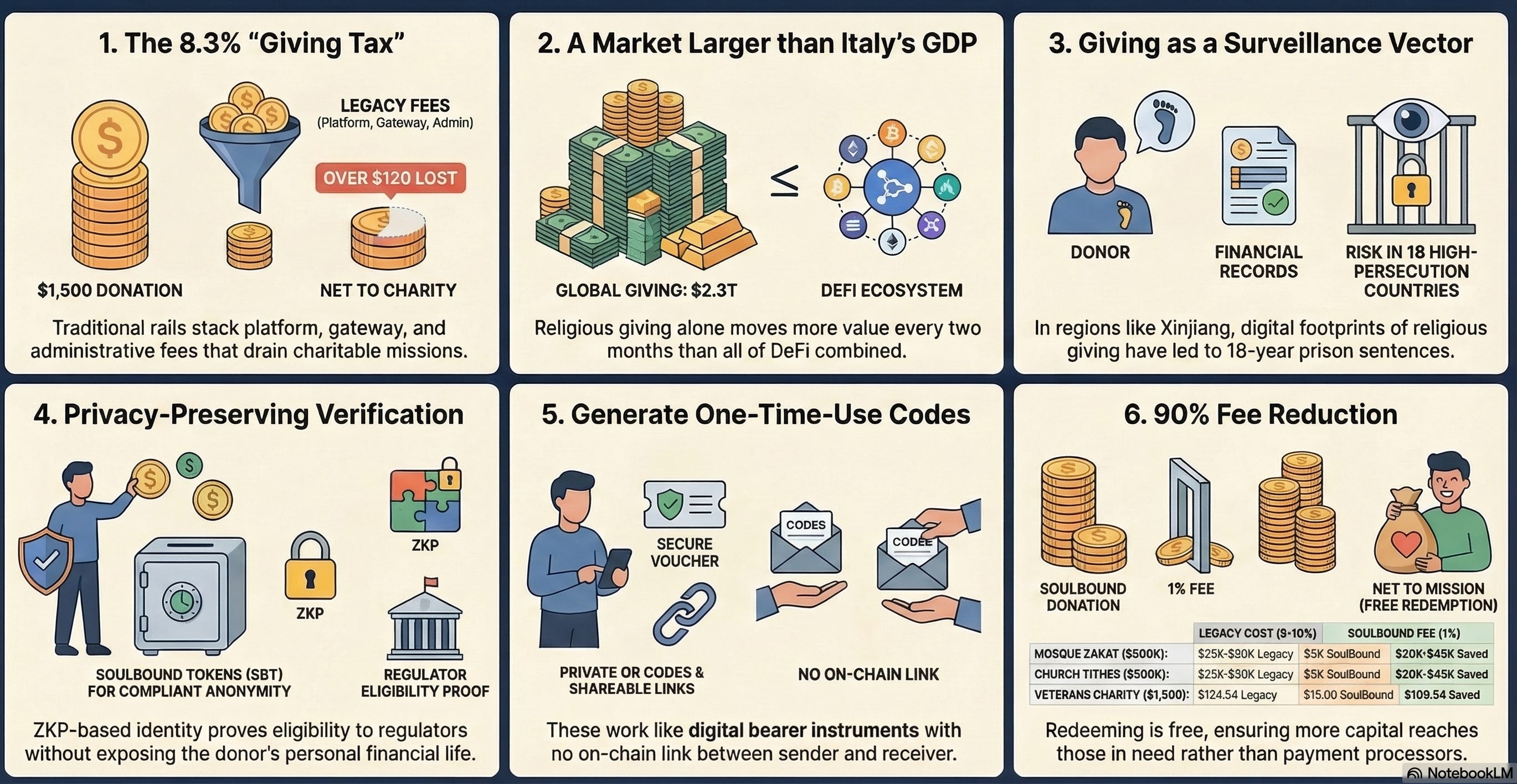
Global charitable giving hit $2.3 trillion in last year. That’s not a typo; $2.3 trillion which is larger than the GDP of Italy.
Religious giving alone dwarfs most DeFi categories. In the US, religious organizations received $146.54 billion last year — the single largest charitable subcategory, bigger than education, health, and human services. Globally, Islamic zakat — the obligatory 2.5% annual wealth contribution that is one of the Five Pillars — is estimated at $600 billion per year by itself. The UNDP and World Bank place the total annual zakat pool between $200 billion and $1 trillion.
Add Christian tithing outside the US, Hindu dana, Jewish tzedakah, Sikh dasvandh, Buddhist giving, and the vast network of informal community-based giving in every faith tradition — and global faith-based giving conservatively exceeds $1 trillion annually.
For context: all of DeFi had roughly $170 billion in locked assets at peak. The religious giving market moves that amount every two months.
Every dollar of it runs on Stripe, Square, PayPal Giving Fund, and legacy card rails extracting 5-10%. There is no DeFi product serving this market. Zero. The entire stablecoin ecosystem has ignored the single largest recurring payment category in the world.
Two Reasons Why It’s Ignored (And Why That’s the Opportunity)
First, it’s not sexy. Crypto builders chase trading, lending, and speculation. Charitable giving doesn’t generate yield, doesn’t create leveraged positions, and doesn’t produce governance tokens. It’s a payment — and payments are “boring.”
Except Stripe just paid $1.1 billion for stablecoin payment infrastructure. PayPal launched PYUSD. Coinbase embedded USDC into Base. The market has figured out that stablecoin payments are the real endgame. Charitable giving is just the payment vertical nobody’s claimed yet.
Second, it requires privacy. This is the part crypto has struggled with since Tornado Cash.
A donor sending $500 to their local food bank doesn’t want that on a public ledger. A family tithing 10% of their income doesn’t want their financial life visible to anyone who looks up the church’s receiving address. These aren’t criminals. They are the most generous segment of the global population, and they need the same privacy that a cash donation in a collection plate has always provided.
The existing privacy tools in DeFi — mixers and shielded pools — are either sanctioned, abandoned, or designed for crypto-native power users. Nobody has built a privacy-preserving payment product simple enough for a church treasurer to use.
Where Privacy Becomes a Safety Requirement
And then there’s the part of this market where privacy isn’t about preference — it’s about survival.
The USCIRF 2026 Annual Report identifies 18 countries where governments engage in “particularly severe” violations of religious freedom. Two-thirds of the world’s population lives in nations where religious communities face persecution. In those jurisdictions, a financial record of a charitable donation is a surveillance vector.
In China, the CCP has made charitable giving itself a crime for certain communities. In testimony before the Congressional-Executive Commission on China in November 2025, ChinaAid’s president described the government’s latest crackdown as explicitly targeting the criminalization of tithing, offerings, and normal church finances.
For Uyghur Muslims in Xinjiang, it’s worse. China banned zakat — the obligatory Islamic charitable contribution — in the region in 2016. Uyghur businessman, Elijan Ismail, organized charitable donations to community members in need. Police branded his group of donors an “ethnic separatist group.” He was sentenced to 18 years in prison for giving money to people who needed it.
This is a region with 400 million surveillance cameras, facial recognition systems built to track ethnic and religious minorities, and mandatory phone monitoring apps. Financial transactions are cross-referenced against identity databases. The infrastructure that made his giving visible is the infrastructure that put him in prison.
Nigeria. India. Pakistan. North Korea. The pattern repeats: Uyghur Muslims, Chinese Christians, Baha’is, Ahmadiyya communities, Tibetan Buddhists — authoritarian governments use financial records to identify and punish people for the act of giving to their own communities.
Cash solved this for centuries. The collection plate, the zakat box, the charity basket — anonymous by design. Digital payments eliminated that privacy, and nobody in crypto has built the replacement yet.
SoulBound: 1% Fee. No Payment Trail. Cash-Like Simplicity.
This is the product we’ve been building.
A donor deposits stablecoins into their private SoulBound account — verified once at entry via soulbound token and ZKP-based identity. They generate a one-time-use code for any amount — a QR code or a shareable link. That code is the donation. The recipient redeems it to any wallet. No login required. No payment trail between sender and receiver. No database linking the two.
1% flat fee. That’s it.
On a $1,500 Folds of Honor donation: $15 instead of $124.54.
For a mosque handling $500,000 in annual zakat collections, or a church processing the same in tithes: $5,000 instead of $25,000-$50,000 lost to processors. That’s $20,000-$45,000 back in the budget every year. Staff positions. Building repairs. Food for families.
Redemption is free. The code works like digital cash — bearer instrument, redeemable by anyone who holds it, on their timeline, to their address. Like handing someone an envelope, except it works across borders and the denomination is dollar-stable.
The Super Bowl pool problem we wrote about in January? Same architecture, different vertical. OTU codes solve group payout distribution for prediction markets, and they solve private giving for $1 trillion in annual religious donations. The infrastructure is identical.
April 20: Mainnet Beta on Arbitrum
We’re going live April 20, 2026.
Initial launch is a mainnet beta focused on charitable and religious giving, deployed on Arbitrum One. USDC and native ETH supported at launch.
Geo-restricted beta. Not available in the US, UK, or EU at launch. Access requires EULA acceptance and a cryptographic signature confirming jurisdictional eligibility. Standard DeFi launch practice — Polymarket ran this exact playbook before achieving regulatory clarity domestically.
We’re simultaneously entering the FCA’s stablecoin regulatory sandbox in the UK, targeting full US/UK availability in 2027.
Core protocol ships AGPL-3.0 before launch. Open infrastructure, composable by default. More on that in our next post.
The communities that need this most are operating outside Western regulatory jurisdictions — where payment infrastructure extracts the most, where financial privacy carries the highest stakes, and where $1 trillion in annual giving is waiting for a better rail.
SoulBound is that rail.
SoulBound Finance launches on Arbitrum, April 20, 2026.
Follow: soulboundsecurity.substack.com