

Soulbound Security Ltd · 31337 Security Research · 17 November 2026
Key Findings
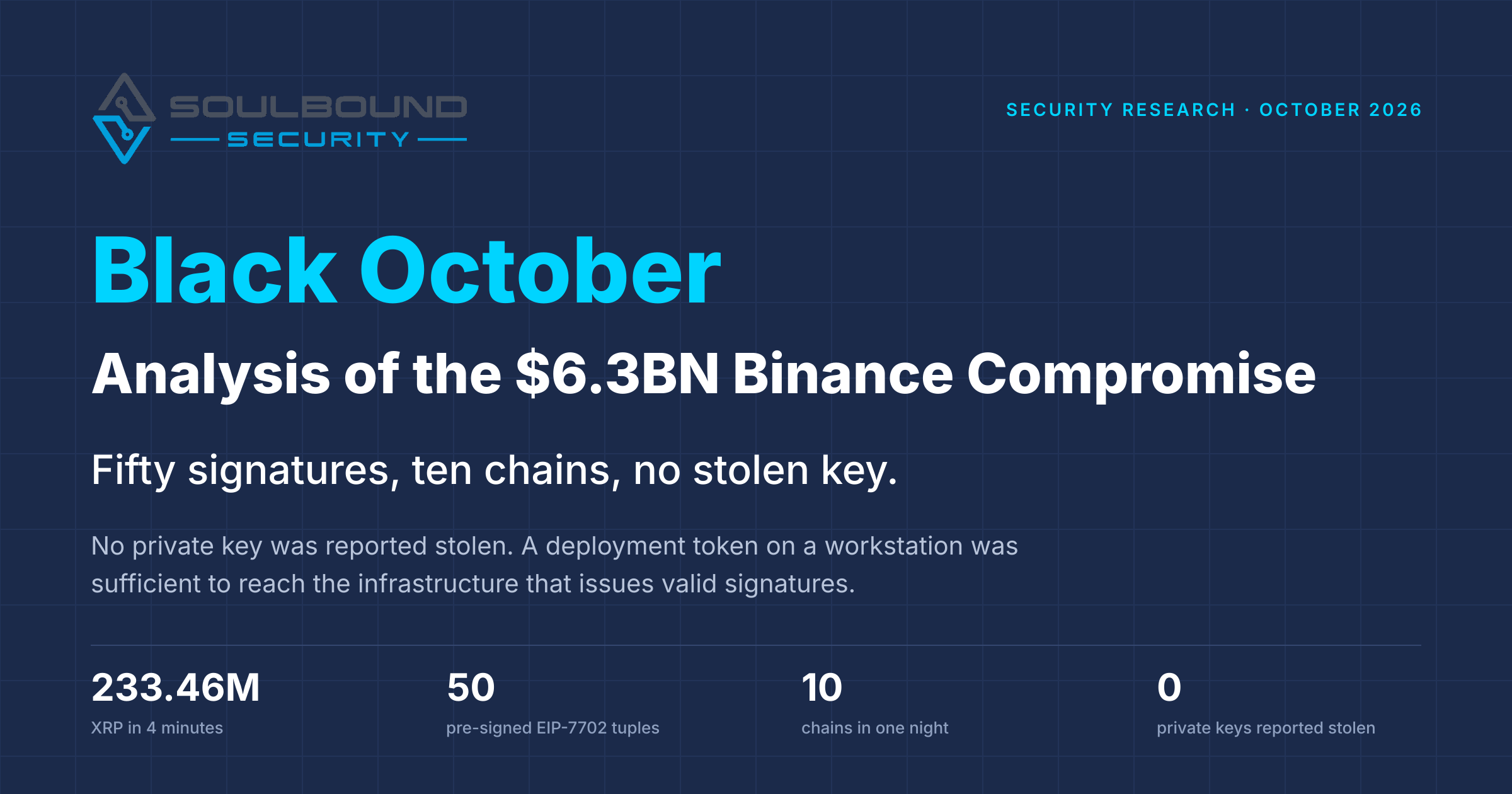
Impacted assets are estimated at $6.34 billion (Binance) to $6.4 billion (Chainalysis), the variance attributable to valuation method and snapshot time. TRM Labs assesses it as the largest cryptocurrency theft on record, approximately four times the February 2025 Bybit incident. The FBI attributes the activity to North Korea under the TraderTraitor designation; TRM Labs and Chainalysis published assessments consistent with that attribution.
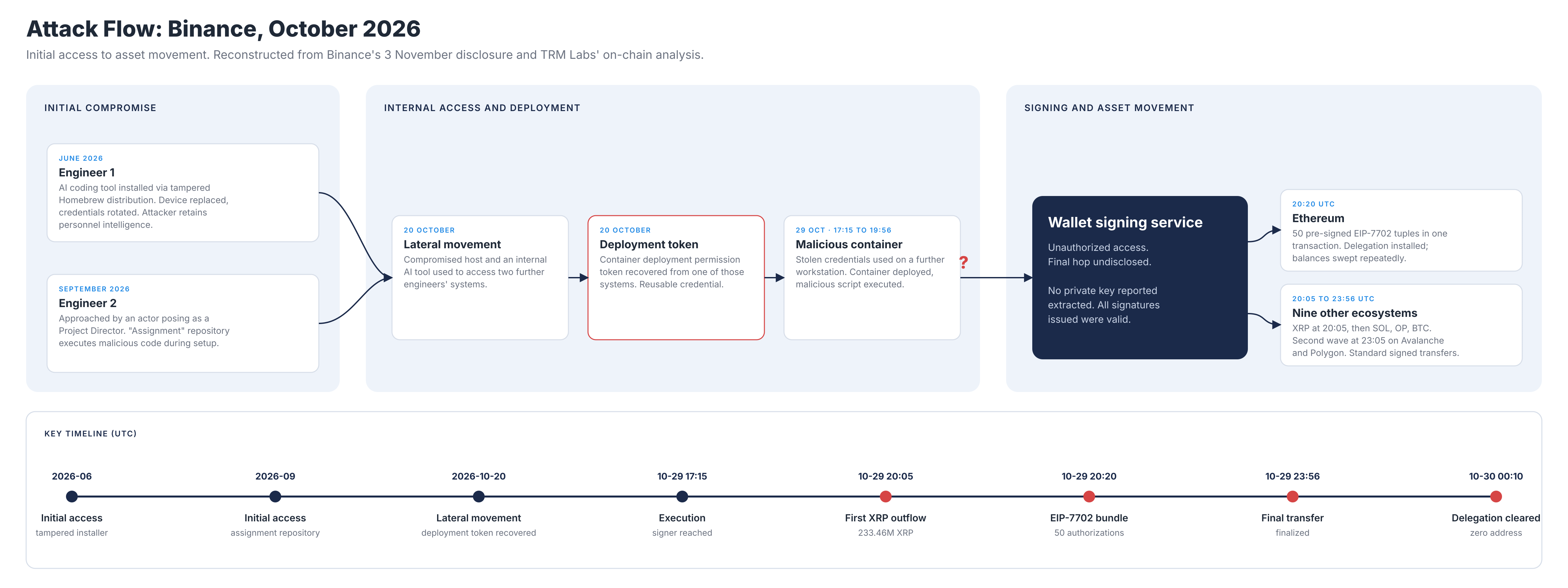
Binance has not reported that a wallet private key was extracted. Its public account describes a chain from an engineer’s workstation, through an internal AI tool and a container deployment permission token, to a deployed container and unauthorized access to an internal wallet-signing service. The final hop into the signing service is undisclosed.
Suspending withdrawals did not halt the Ethereum losses. The EIP-7702 delegation was an on-chain state that continued to sweep new deposits until Binance cleared it at 00:10 UTC on 30 October. Binance states that its MPC configuration prevented any single key from clearing the delegation immediately.
The attacker did not require key material. The attacker required access to the infrastructure from which valid signatures can be requested, and acceptance there as an authorized caller. That is a control-plane failure, not a cryptographic one.
Access Campaign
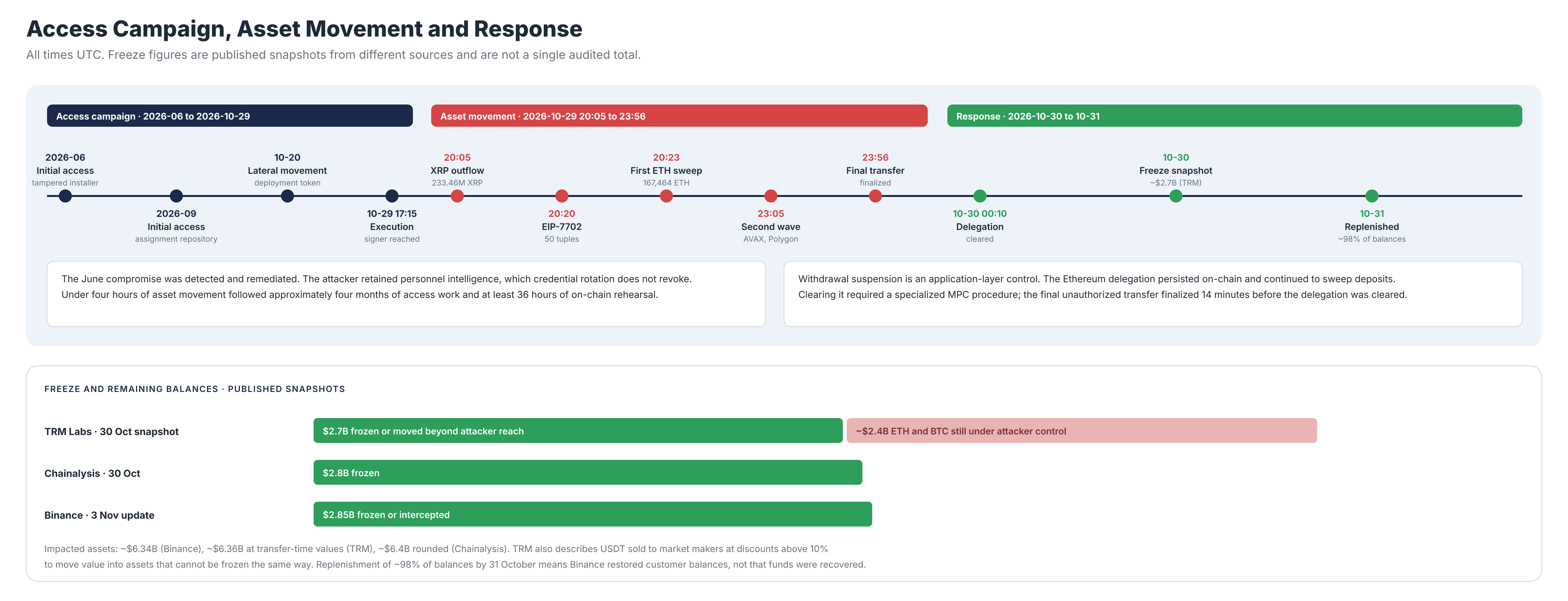
The asset movement phase lasted under four hours. The access campaign that preceded it ran for approximately four months. Dates and times for each stage are given in Figure 1. The campaign is mapped below to MITRE ATT&CK Enterprise tactics and techniques. Pre-incident stages are drawn from Binance’s 3 November disclosure; asset movement is drawn from TRM Labs’ on-chain analysis. Workstation and malware details are Binance’s findings; no host forensic evidence has been published that would allow independent reproduction of those steps.
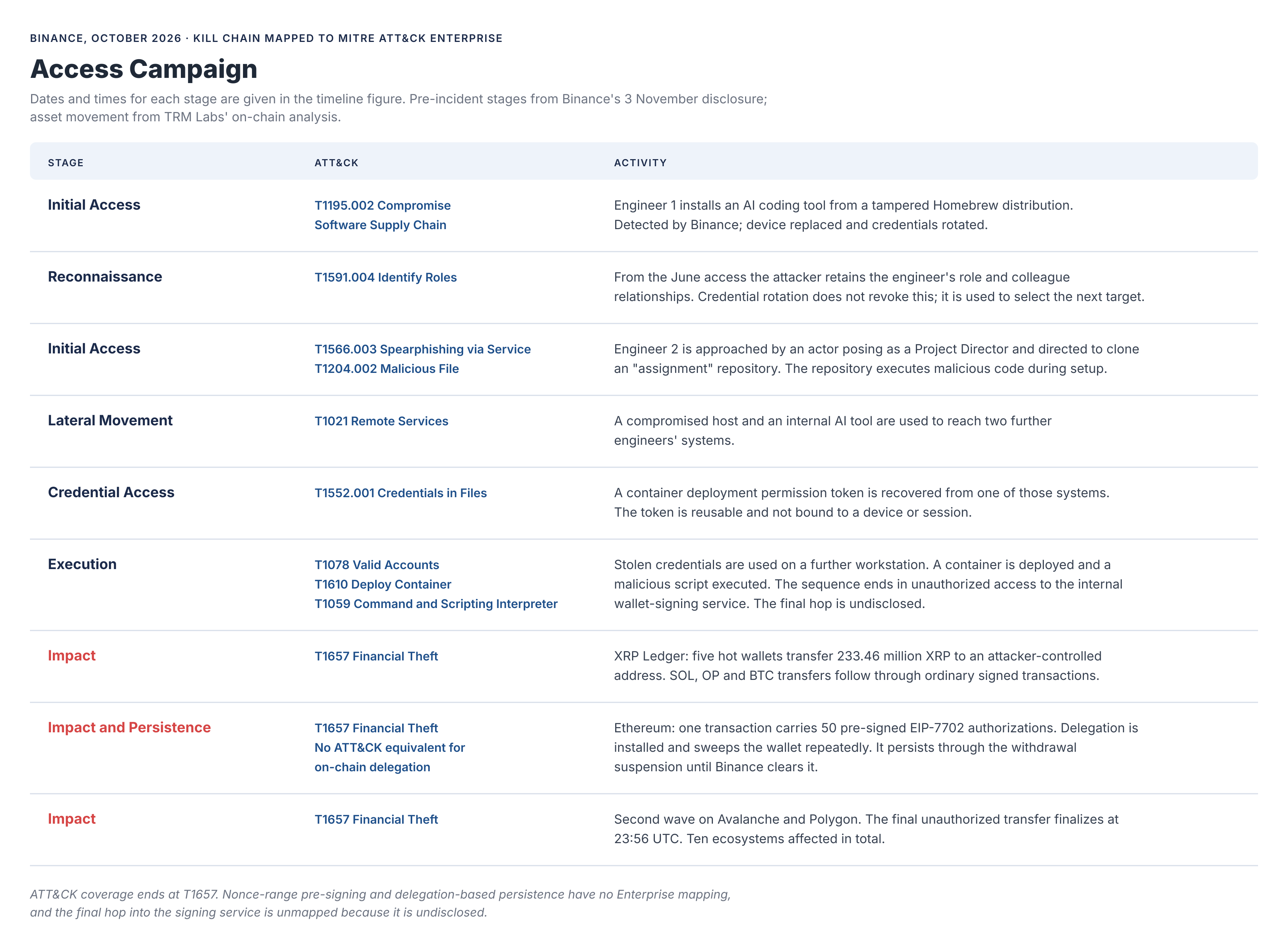
The techniques that define this incident on-chain, nonce-range pre-signing and delegation-based persistence, have no Enterprise mapping, and the one step that matters most, the final hop into the signing service, is unmapped because it is undisclosed.
Two aspects of the campaign are relevant to the analysis that follows. First, the June compromise was detected and remediated, and that remediation did not alter the outcome: the attacker’s gain from it was personnel intelligence, which rotation does not revoke. Second, the October lateral movement was conducted through an internal AI tool, an asset the organization had deliberately provisioned with reach into engineering systems.
TRM Labs additionally documents on-chain preparation beginning at least 36 hours before the first outflow: Tornado Cash withdrawals funding an operator wallet, test code deployed to two wallets, and a rehearsal on a third, with funds returned during testing.
Technical Analysis: Ethereum
EIP-7702 delegation
EIP-7702 allows an externally owned account (EOA) to delegate execution to existing smart-contract code. The EOA signs an authorization tuple identifying the delegate contract, bound to a chain ID and to the EOA’s current nonce. When a type-4 transaction includes that tuple, a delegation designator is written to the EOA. Subsequent calls to the EOA execute the delegate’s code in the EOA’s own account context, with full access to its balances. The private key is neither exposed nor transferred at any stage.
The nonce binding is a replay defence. EIP-7702 validates each authorization against the authority account’s nonce at processing time, so a stale authorization cannot be reused. For a high-throughput exchange wallet, this also means that any single pre-signed authorization has a short validity window, because the wallet’s own routine transactions advance the nonce continuously.
Fifty authorizations, fifty nonces
Binance states that the attacker submitted 50 signing transactions in order to manipulate the account nonce. TRM Labs observes a single Ethereum transaction at 20:20 UTC carrying 50 pre-signed authorizations, each signed by the Binance hot wallet for a distinct nonce value.
Our assessment is that 50 signing requests to the compromised signing path produced 50 authorizations covering a contiguous nonce range, and that these were bundled into one transaction so that whichever authorization matched the live nonce at processing time would install the delegation. This reconciles the two accounts. It is an inference; neither source states it explicitly.
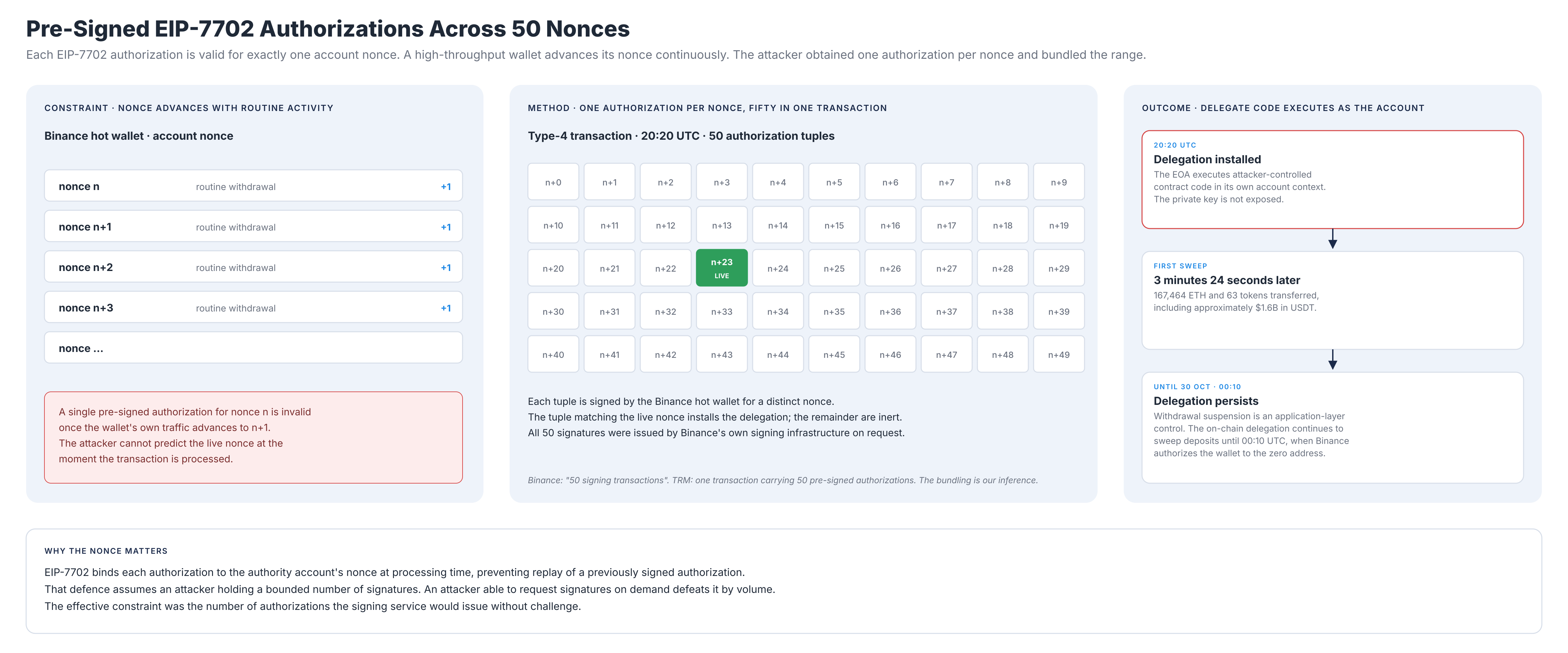
The nonce defence in EIP-7702 assumes an attacker holding a bounded number of signatures. An attacker who can request signatures on demand defeats it by volume. The constraint on the attack was therefore not the protocol but the number of authorizations the signing service was prepared to issue without challenge.
Impact and persistence
Three minutes and 24 seconds after the authorization transaction, TRM Labs reports the delegated wallet transferred 167,464 ETH and 63 tokens, including approximately $1.6 billion in USDT.
The delegation persisted after the initial sweep. Deposits arriving at the wallet were swept repeatedly through the evening. Binance’s suspension of withdrawals, an application-layer control, had no effect on this behaviour, because the delegation was an on-chain fact independent of Binance’s withdrawal pipeline. The final unauthorized transfer finalized at 23:56 UTC. Binance cleared the delegation at 00:10 UTC on 30 October by authorizing the wallet to the zero address.
Binance states that no single private key was available to authorize that clearing immediately and that a specialized MPC procedure was required. This is a statement about operational readiness for revocation under a threshold-signing scheme. It is not evidence that MPC was bypassed or that a conventional key was stolen. The property that prevents any single party from acting alone applied equally to the defenders.
Technical Analysis: Other Chains
Binance hot wallets on nine further ecosystems transferred funds through ordinary signed transactions. No delegation mechanism was involved. TRM Labs documents activity across ten ecosystems in total, with the second wave at 23:05 UTC affecting Avalanche and Polygon.
EIP-7702 accounts for the Ethereum mechanism only. It does not account for the XRP, SOL, OP, BTC, Avalanche or Polygon transfers, and compromise of a single chain’s key would not account for them either. TRM Labs’ interpretation, consistent with Binance’s disclosure, is that the attacker reached the hot-wallet signing infrastructure or a privileged path capable of submitting requests to it. One signing service holding authority across all chains, accepting requests from a caller it treated as authorized, is the most parsimonious explanation for ten ecosystems moving within a four-hour window.
Response
TRM Labs’ 30 October snapshot records approximately $2.7 billion frozen or moved beyond the attacker’s reach, with approximately $2.4 billion in ETH and BTC remaining under attacker control. Chainalysis subsequently reported approximately $2.8 billion frozen. Binance’s 3 November update places its frozen and intercepted figure at approximately $2.85 billion. These are different snapshots using different categories and should not be read as a single recovery total.
TRM Labs also documents the attacker selling USDT to market makers at discounts exceeding 10% to convert into assets that cannot be frozen by an issuer.
Binance confirmed it would absorb the loss and reported, as of 31 October, that approximately 98% of impacted token balances had been replenished. Replenishment restores customer balances from exchange reserves. It is not recovery of stolen assets.
Assessment: Control-Plane Access to Signing Infrastructure
Exchange wallet security is conventionally described in three layers:
Key custody. HSMs, MPC, hardware signers. Where key material lives and how it is split.
Signing policy. What the signer will sign: permitted destinations, limits, transaction and authorization types.
Infrastructure and operations. The systems that deploy, configure and invoke the signer, and the identities and credentials that control them.
Post-incident analysis typically concentrates on the first layer, because key compromise is the failure mode the industry is organized to detect. Binance has not reported one. Its account describes unauthorized access to a signing service reached through a deployment token and a deployed container. That is a third-layer failure which produced correct output from the first layer: every signature issued on 29 October was cryptographically valid and, by the signer’s own rules, legitimate.
Who is authorized to request an operation from the infrastructure that controls signing, and how does that infrastructure verify that the request was approved by them?
The failure is clearer when the signer’s callers are separated into two planes:
Hot path. Routine withdrawals. High volume, automated, governed by signing policy, limits and monitoring. This is where a decade of exchange security investment has gone.
Control plane. Deployments, signing-policy changes, access-control changes, credential rotation and signer configuration. Low volume, high impact, performed by operators or by privileged services acting for them.
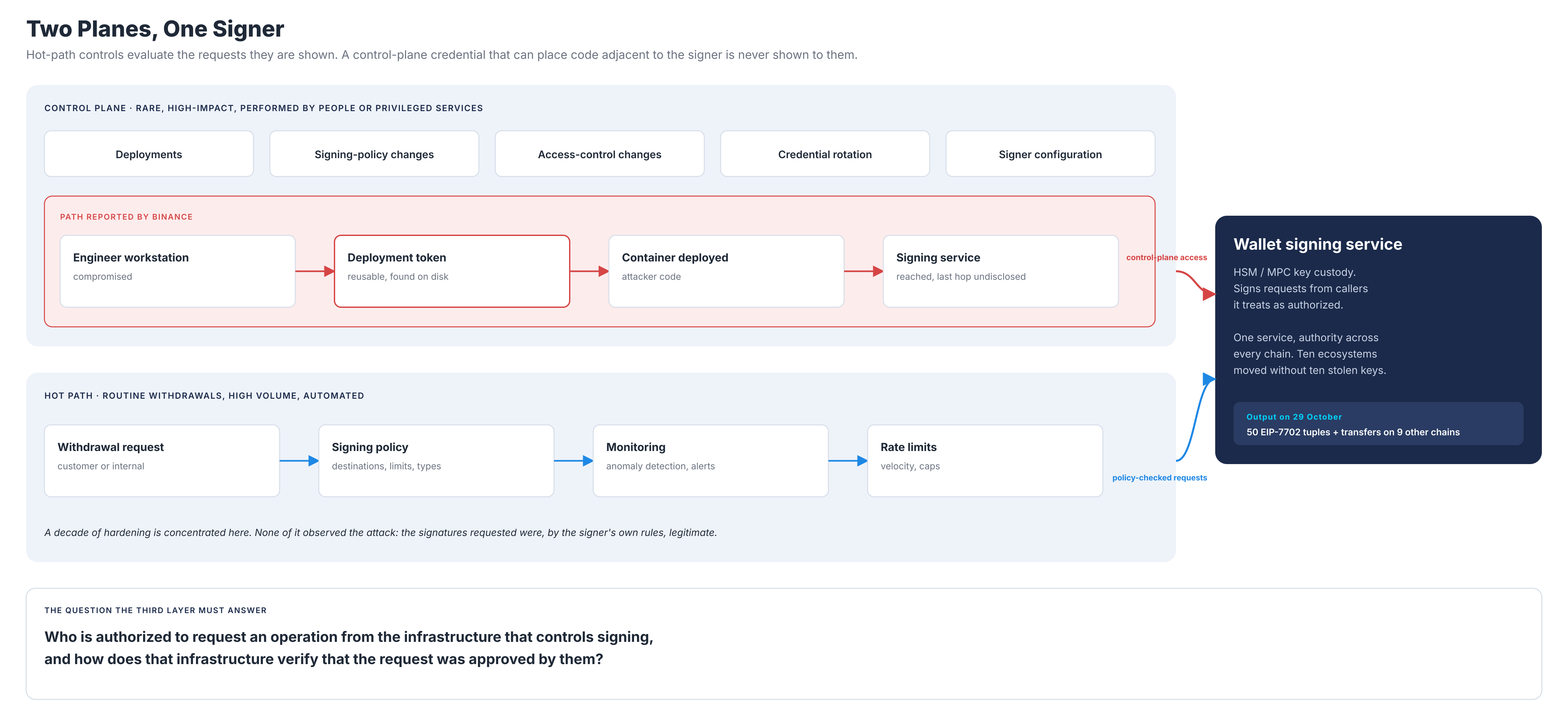
If a reusable deployment credential is sufficient to execute a privileged deployment, and a privileged deployment can reach the signing service, then a workstation compromise is a control-plane compromise, and a control-plane compromise is a hot-wallet compromise.
No hot-path control is positioned to observe that chain, because the requests arriving at the signer are, from its perspective, well-formed and authorized.
This is a semantic failure of the same class we documented in the Nomad bridge analysis, When Zero Meant Trusted. There, a storage default meaning “no proof recorded” was read by validation logic as “trusted root.” Here, a credential meaning “may deploy containers” was accepted by infrastructure as “may stand adjacent to the signer.” In both cases the check executed correctly against a value whose meaning had changed across a trust boundary.
Recommendations
For operators of signing infrastructure, the published record supports four controls as directly responsive to this incident.
Eliminate standing deployment credentials from workstations. Replace with short-lived, narrowly scoped or hardware-bound credentials. Any long-lived token recovered from an endpoint during assessment should be treated as a finding.
Require per-action, operator-bound approval for control-plane operations, including deployments that can reach the signer, signing-policy changes, destination additions and limit changes. The gate must cover service-to-service and alternate API paths, not only the operator console. The most sensitive changes should require two operators approving the same payload.
Enforce deny-by-default signing policy at the signer boundary. Withdrawal pipelines have no routine need to sign EIP-7702 authorizations. Unusual authorization and transaction types should require an explicit, reviewed exception, and destination, asset and amount constraints should be enforced by the signer independently of caller authentication.
Rehearse on-chain revocation. Where clearing a delegation or standing approval requires a threshold-signing ceremony, that ceremony should be documented, assigned and exercised before it is needed. Internal AI tooling with reach into engineering systems should be included in the attack-surface inventory and assessed as a lateral-movement path.
Soulbound Security · Security Services
What We Do for Others
The analysis above is the public version of the work we offer under NDA for exchanges, custodians, protocols and the teams that invest in them: trace every path that can instruct a signer, find the credential that is sufficient on its own, and fix the seam before someone else finds it.
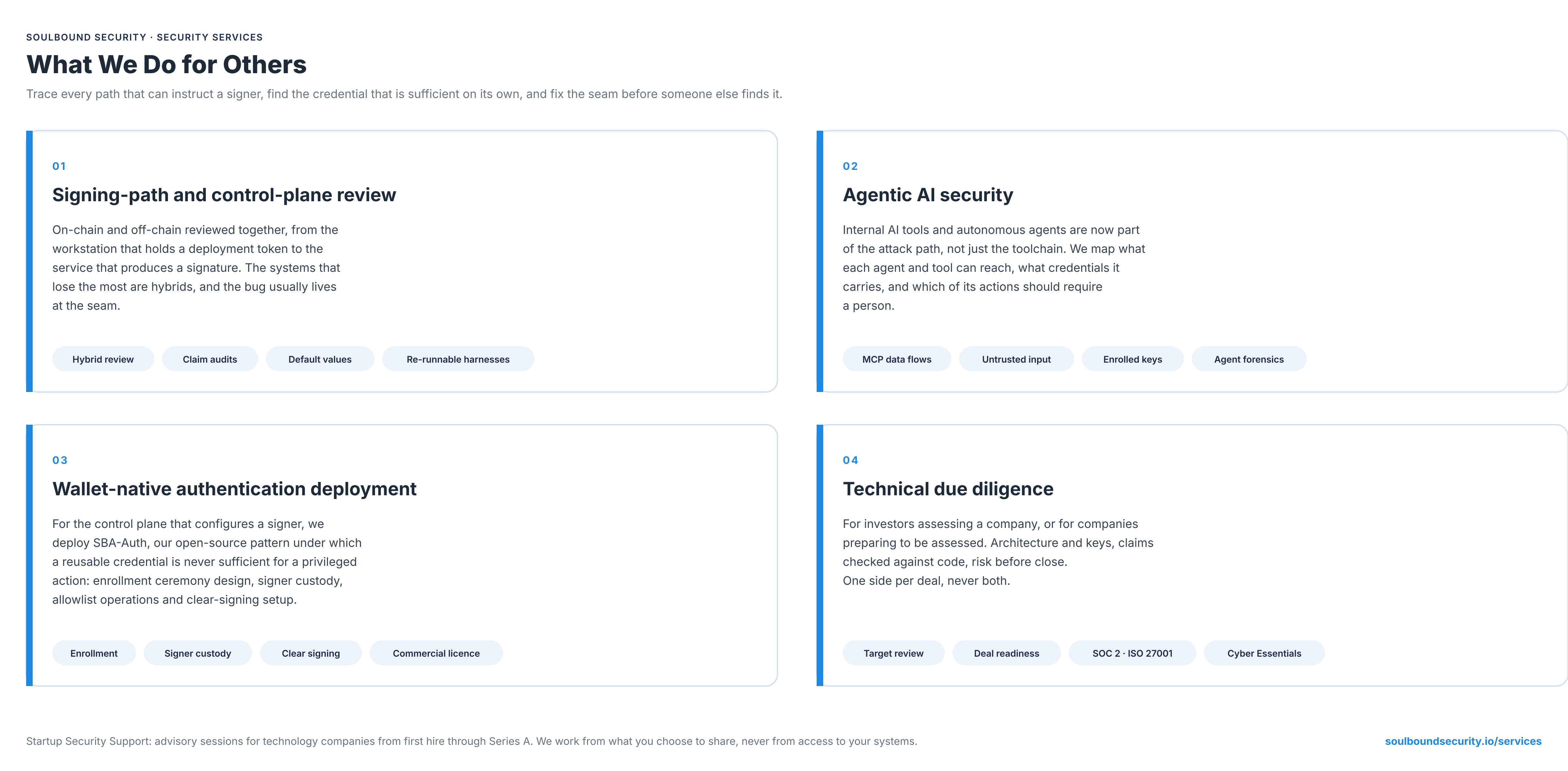
For technology companies from first hire through Series A, Startup Security Support is a set of advisory sessions that bring enterprise security experience to the stage where good decisions are cheap and poor ones compound.
We work from what you choose to share, never from access to your systems.
Our full service list is at soulboundsecurity.io/services
About Soulbound Security
Soulbound Security is a blockchain security and technology company. We design and ship systems where privacy, compliance, and auditability are architectural properties, not policy promises, and our 31337 security research team reviews our own work the way it reviews everyone else’s.
Soulbound Security is approved under Anthropic’s Cyber Verification Program.
Sources
Binance, 29 October 2026 Security Incident (3 November 2026). Official incident reconstruction, signing-service access, $6.34B impacted figure, 50-signing-transaction description, final transfer and delegation-clearing timeline.
TRM Labs, North Korea Steals USD 6.36 Billion From Binance (29 October 2026). Independent on-chain analysis, transfer-time valuation, 50 EIP-7702 tuples, cross-chain flows and attacker-balance snapshot.
Chainalysis, The $6.4 Billion Binance Hack (30 October 2026). Independent estimate, cross-chain analysis and frozen-funds assessment.
FBI, North Korea Responsible for $6 Billion Binance Attack (31 October 2026). Official DPRK and TraderTraitor attribution.
Ethereum, EIP-7702: Set EOA Account Code. Primary specification for authorization tuples, nonce processing and delegation execution.
Soulbound Security, When Zero Meant Trusted (October 2026). The Nomad analysis referenced above.
Soulbound Security, SBA-Auth 1.1: Four Factors, One Key (20 October 2026).